

Happy and Healthy
In Your Own Skin
Mohs Skin Cancer Surgery
Colorado Skin Surgery & Dermatology strives to give our patients the best in skin cancer treatment, which also involves skin cancer detection and skin cancer prevention. Our Board Certified Dermatologists are trained in Mohs surgery and specialize in the treatment of skin cancer. Dr. Shayla Francis is a Mohs micrographic surgery specialist and has the expertise allowing her to treat all forms of skin cancer, ensuring the highest cure rates while maximizing cosmetic results. She is an active member of the American Society of Dermatologic Surgery, making her an esteemed member of our institution. To schedule an appointment, don’t hesitate to contact us today.
What is Mohs Surgery?
Mohs micrographic surgery is the most effective and advanced treatment for skin cancer today. It offers the highest potential for cure, even if the skin cancer has been previously treated by another method. Mohs surgery treats skin cancer through a highly specialized and precise technique that removes the cancer in stages, one tissue layer at a time. The Mohs procedure involves surgically removing skin cancer layer by layer, and examining the tissue under a microscope until healthy, cancer-free tissue around the tumor is reached (called clear margins). Because the Mohs College surgeon is specially trained as a cancer surgeon, pathologist, and reconstructive surgeon, Mohs surgery has the highest success rate of all treatments for skin cancer.
Mohs surgery has up to 99% cure rate for a skin cancer that has not been treated before and up to a 94% cure rate for skin cancer that has recurred after previous treatment. The removal of cancerous cells leaves the integrity of healthy cells behind and leaves the smallest possible scar. It is a technique that is practiced and promoted around the world. Mohs surgery is an attractive option for its high success rate, but it is also an efficient and cost-effective treatment. Treatment is usually a single-visit outpatient surgery and lab work is done on-site.
Why It’s Done
Mohs surgery can be used to treat most common skin cancers, like basal cell carcinoma and squamous cell carcinoma, as well as some forms of melanoma and other, more unusual forms of skin cancer. You may want to consider Mohs surgery if your skin cancer applies to the following:
- Your skin cancer has a high risk of recurrence, or it has occured after previous treatment
- It is located in areas where you want to preserve as much healthy tissue as possible, like around the eyes, nse, mouth, hands, feet, and genitals
- The skin cancer has borders that are hard to define
- It is large and aggressive

The Mohs Surgery Process

Step 1
The roots of a skin cancer may extend beyond the visible portion of the tumor. If these roots are not removed, the cancer will recur.
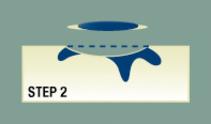
Step 2
The visible tumor is surgically removed.
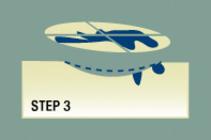
Step 3
A layer of skin is removed and divided into sections. The ACMS surgeon then color codes each of these sections with dyes and makes reference marks on the skin to show the source of these sections. A map of the surgical site is then drawn.
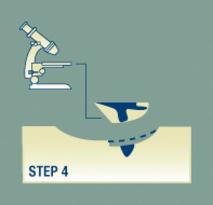
Step 4
The undersurface and edges of each section are microscopically examined for evidence of remaining cancer.

Step 5
If cancer cells are found under the microscope, the ACMS surgeon marks their location onto the “map” and returns to the patient to remove another layer of skin – but only from precisely where the cancer cells remain.
Is Mohs Treatment Right For You?
Because of its success rate, Mohs is recommended as the treatment of choice for high-risk nonmelanoma skin cancers located on the nose, eyelids, lips, ears, hands, feet, and genitals. Mohs skin cancer surgery is best used to treat large cancers in normally low-risk areas, those with difficult-to-see borders, those with certain microscopic growth patterns, those that have recurred after initial treatment, and those that could not be completely removed.
Mohs surgery is the front-line treatment for nonmelanoma skin cancers that grow in scar tissue or areas of prolonged inflammation. Nonmelanoma skin cancers are considered high-risk because they develop in patients whose immune systems are suppressed by medications, disease, or those who predisposed to developing skin cancer. For low-risk forms of BCCs and SCCs, standard treatments like surgical excision, cryosurgery, curettage, and electrodesiccation are typical.
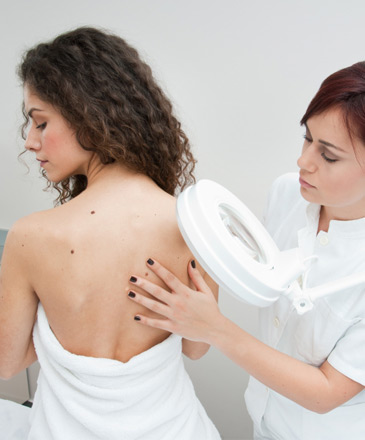
Even if you do have a low-risk form of BCCs or SCCs, it is crucial that you seek treatment as soon as possible, as failure to do so means that you face more extensive surgery in the future. Start performing at-home skin exams and schedule skin exams with your local dermatologist in Denver. Mohs surgery delivers the best cosmetic results and the lowest recurrence rate of any treatment method, so don’t hesitate to schedule an appointment with our Board Certified Dermatologists in Denver today. We are happy to help you on the first step of your skin cancer treatment!
Skin Cancer
Patients often ask, “What can I do to protect myself from skin cancer?” Unfortunately, your skin’s sun damage cannot be completely reversed. However, several precautions can be taken to reduce your risk of developing skin cancers.
COSMETIC
It is important to remember that, in both men and women, good-looking skin is usually healthy skin. You will look better after our cosmetic procedures, but more importantly, our goal is that your skin will also be healthier.
Our experienced dermatologists will help you find the procedures that are right for you, creating a care and treatment plan that may help you to overcome issues with your face, body, skin and more!